Wednesday, September 11, 2013

Hellbender Trip 2013

The Herp Club kicked off the year with our annual Hellbender Trip. Where, as in the past, we ventured to western New York to find hellbenders, Cryptobranchus alleganiensis, (we kept our eyes out for other herpetofauna as well). The 14 individuals in our group were led by Mr. Kenneth Roblee, from the New York State Department of Environmental Conservation (NYSDEC).
Hellbenders are incredible animals, and not just from their immense size (they can get up to 30 inches in length). They are also 1 of 3 species of giant salamanders (Family: Cryptobranchidae), the other 2 are the Japanese and Chinese Giant Salamanders. These animals spend their adult lives fully underwater. They also have a unique breeding system, where after fertilizing the eggs, the males will remove the females from the den and guard them by themselves (they guard them ferociously).
However, these animals have also been seeing declines in populations recently. Luckily there is a headstart program going on for the hellbenders, where various zoos (like the Buffalo Zoo) are collecting eggs from the wild and raising the hellbenders to an age where they can survive in the wild on their own and then they are released. Similar to last year, we were able to collaborate with the Buffalo Zoo and assist in releasing about 20 of their headstarted hellbenders. We were also able to find some adults while we were wading around, including two large adults measuring about 22 inches in length! The trip was very fun, and we would like to thank Mr. Roblee and the Buffalo Zoo for giving us such a great experience:


Group picture with Mr. Roblee
Photo Courtesy of Mrs. Richard Bothner

Most of the group gathered around Mr. Roblee to see the proper way to release a young hellbender.

A herp club member releasing a young hellbender into its new home.


Beautiful in their own way, right? Can you believe that these guys are also called 'snot otters' or 'devil dogs'?
Photo Courtesy of Jonathan Gorman

An adult that was found early on, measured 17 inches!
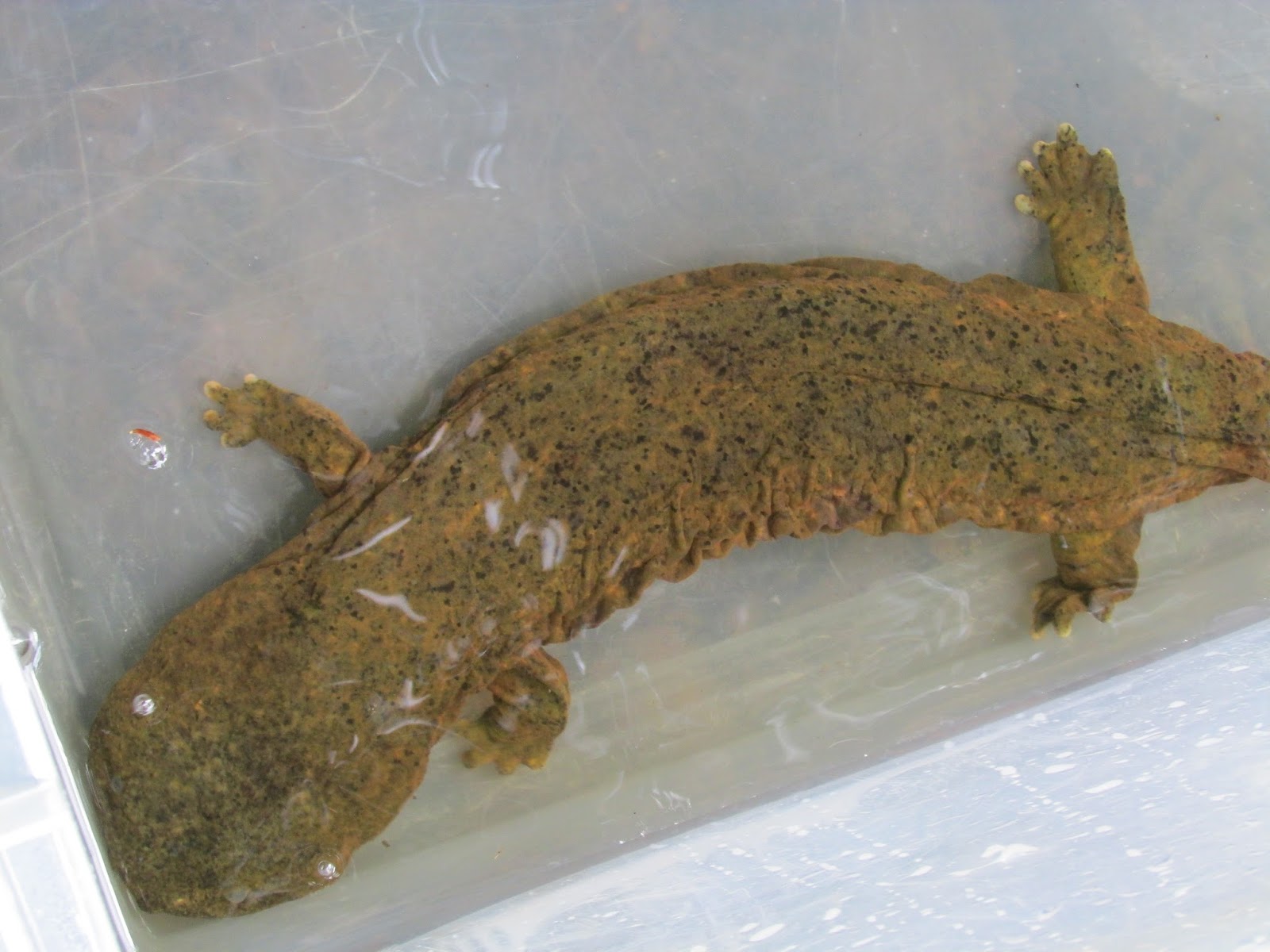


Taking measurements for the newly found adult male. We helped to gather data which included length (snout-vent length and tail length), weight, GPS location, depth of its den, and size of the den. After which, a transmitter was placed in it so that the animal could be readily identified in the future.


Their skin has a wrinkly edge, the animals themselves are coated so well in a slime that they feel very smooth to the touch.


A look at the underside of their feet.

An adult with a wound on its leg, which is a regular occurrence. As was mentioned earlier, they will defend their dens ferociously, to death even.


Another adult being measured. We ensured that the animals remained moist, to prevent desiccation, and to reduce their stress.


At times, they would allow you to pose them, however, when they struggled it was highly difficult to maintain a hold on them (imagine gripping a wet, wriggling bar of soap).


We also saw some other cool animals:
A mountain dusky salamander (Desmognathus ochrophaeus)


Slimy salamander (Plethodon glutinosis)


Bullfrog (Rana catesbeiana)


A little American toad (Anaxyrus americanus)


A lovely lamprey, being its parasitic self.
Photo Courtesy of Jonathan Gorman
For more information on the work that Mr. Roblee and the Buffalo Zoo have been doing, see: http://www.dec.ny.gov/public/73572.html


 Post and Undesignated Photos by:
Joey Chase

Tuesday, May 21, 2013

2013 Spring Field Survey at Steege Hill Nature Preserve

As we have done in the past, we held our semesterly field survey, on April 28th. We teamed up with the Finger Lakes Land Trust to do a survey of one of their properties, to see what kinds of herpetofauna they had as well as the relative abundance. This year we went to Steege Hill, located in Big Flats (near Corning). Steege Hill is known for having a variety of herps on it, including New Yorks only native lizard: the northern coal skink (Plestiodon antrhacinus anthracinus), as well as the infamous timber rattlesnake (Crotalus horridus).

Our group this year was very large, consisting of over 30 members (ranging from students, faculty, alumni, community members, and children). However, the big size made the survey even more thorough, where more rocks and logs were flipped over (and put back where they were found). As a result, we had found quite a few animals.

A shot of most of the group, gathering around at our first location to learn about ants...? (Find out more below)
Photo Courtesy of Brian Worthington

This huge mound is home to Allegheny mound ants (Formica exsectoides). Something to note, besides the size of the structure, these ants will also inject formic acid into woody plants around them to prevent plants from shading the mound.
Photo Courtesy of Sophie Liu

As happened in the past, our most abundant find were of redback salamanders (Plethodon cinereus). It wasn't unheard
 of to find several of these aptly named salamanders under one rock or log.Photo Courtesy of Brian Worthington

This is also a redback salamander (P. cinereus), however it is going through a phase which we call the Leadback, due to the dominant dark pigmentation.
Photo Courtesy of Graham Montgomery

There were a ton of tiny tadpoles swimming about in ponds and vernal pools,
it is difficult to identify them, but speculation was that they may have been 
from wood frogs (Rana sylvatica)
Photo Courtesy of Sophie Liu    

A northern redbelly snake (Storeria o. occipitomaculata), demonstrating how it was given its common name. However, the bright underbelly was not very helpful in spotting these little guys crawling through the leaf litter.
Photo Courtesy of Brian Magnier


Eastern garter snake (Thamnophis s. sirtalis), the photo shows the forked tongues that all snakes have (as well as some lizards and amphisbaenians). They work by gathering particles, which are then analyzed, and the forking allows for the snake to get a relative direction of the scent to follow (if prey) or flee (if predator).
Photo Courtesy of Brian Magnier

Another eastern garter snake (T. s. sirtalis), very common snakes throughout the area (and the species is found throughout the United States). Although they are not likely to bite when picked up, they do have the ability to produce a potent (and not pleasant) musk.
Photo Courtesy of Brian Worthington


Mountain dusky salamander (Desmognathus ochrophaeus), another relatively common salamander of the area. This is a plethodontid salamander, as shown by the nasolabial groove (line from nostril to lip), which is one of their key features.
Photo Courtesy of Brian Magnier

This adorable salamandrid is a red eft (Notophthalmus viridescens), which is the terrestrial, juvenile phase of the Eastern red-spotted newt. These guys have bright coloration, termed aposematic, as a warning to indicate that they are toxic (and to note, all newts [family: Salamandridae] are toxic).
Photo Courtesy of Brian Magnier


This is the highly elusive spotted salamander (Ambystoma maculatum), these salamanders spend the bulk of the year hidden away. The main exception to this is during the breeding season (see our previous post for more details).
Photo Courtesy of Brian Worthington

We took a quick stop in this area to search under some rocks, because we were told that this was a prime location for northern coal skinks (P. a. anthracinus).
Photo Courtesy of Sophie Liu

Our search for the northern coal skink (P. a. antracinus) was successful! Albeit, these feisty little lizards were quick to nip, and incredibly speedy which made them hard to find and catch. When young these lizards have a blue tail.
Photo Courtesy of Brian Worthington


This tiny herp is a ring-necked snake (Diadophis punctatus), which was a great find. 
And, as you can see, they are another of the appropriately named snakes.
Photo Courtesy of Betsy Darlington


An american toad (Anaxyrus americanus), and as with all true toads [Family: Bufonidae], they can produce poison through their paratoid glands (what most would call 'warts') when stressed.
Photo Courtesy of Brian Worthington

Correct, this is not a herp. Rather, it is a large North American millipede (Narceus americanus). Unlike most other millipedes, they do not secrete a cyanide substance, however the substance they release can temporarily discolor skin.
Photo Courtesy of Graham Montgomery


This time of year, we also see the emergence of flowers, 
like this round-lobed hepatica (Hepatica americana).
Photo Courtesy of Audrey Bowe


Our survey was great fun, we had seen a wonderful diversity of herps as well as other flora and fauna (although we did not encounter a timber rattlesnake). See below for the diversity and finalized counts of the herps we found.


Final species count:

Redback salamanders, Phethodon cinereus: 57
     [In leadback phase: 6]
Mountain dusky salamanders, Desmognathus ochrophaeus: 7
Redbelly snakes, Storeria o. occipitomaculata: 6
Garter snakes, Thamnophis s. sirtalis: 5
Coal skinks, Plestiodon anthracinus: 5
Red efts, Notophthalmus viridescens: 2
Spotted salamander, Ambystoma maculatum: 1
Spring peeper, Pseudacris crucifer: 1
American toad, Anaxyrus americanus: 1
Ring-necked snake, Diadophis punctatus: 1

(Plus a bunch of Tadpoles and Eastern Red Spotted Newts [N. viridescens] in the water)


Post by Joey Chase

Wednesday, May 8, 2013

Salamander Migrations, 2013

                  As in the past, the Herpetological Society did rounds to catch the salamander migrations at Bull Pasture Pond. Our visits spanned for about a month long period, with the earliest salamanders arriving in mid-March and the last stragglers leaving the ponds in mid-April. The 'boom' in the migration occurred on March 31st this year, with over 100 individuals seen during that night.

                   For those who have not heard of the salamander migration, it is a unique time of year. During this small segment of time our local species of Ambystomatids (Spotted and Jefferson salamanders) come out to breed. These animals are rarely seen at other times of the year due to their secretive lifestyles. However, when spring approaches, the ground warms up, and the first warm rain hits us, these elusive animals get out of hiding and head for the ponds. The catch being that they travel only at night (traveling during the day can be hazardous to amphibians because of the moisture requirements of their skin), so in order to spot them you need to be nocturnal as well. But it is well worth it once you see these local salamander giants walking in full force.

                    Bull Pasture Pond is a particularly unique area, in that it has a contrast between natural woodland and fully groomed golf course. The salamanders in order to make it to the pond must cross an expanse of golf green (around 50m, but to a 20cm animal that must be a daunting amount), exposing them to risk from predation and environmental harm. So, why would they choose this pond? They have internal navigation that directs them back to the pond they were born in, so that they may return to breed there year after year.

                      This year, some members of the club visited the pond for several nights during the breeding period, in order to catch the breeding season. The two species of salamanders came out during different times, where the Jefferson salamander (Ambystoma jeffersonianum) was the first out, followed soon after by the Spotted salamander (Ambystoma maculatum). When more and more people started watching the migration we also took to assisting the animals cross the road to reduce the number of unfortunate road fatalities. During these visits we chanced upon a surprising variety of herpetofauna coming out of their Winter dormancy.

One of first Spotted salamanders (A. maculatum) of the season, when it was still quite cold.
Photo Courtesy of Brian Worthington

Snow was falling but these salamanders were still on the move
Photo Courtesy of Brian Magnier

An early Jefferson salamander (A. jeffersonianum). Notice they are not solid gray, but are decorated with bluish-gray speckles.Photo Courtesy of Brian Worthington

An Eastern Red-Spotted Newt (Notopthalmus viridescens), the highly aquatic adult form. We most commonly see these in the juvenile form, which we call Red Efts
Photo Courtesy of Audrey Bowe


This Painted turtle (Chrysemys picta) was a surprising find, because it was so cold and early in the season... 
Photo Courtesy of Brian Magnier


This Leopard frog (Lithobates pipiens). Although the hazed over eyes might have made you think otherwise (and if you were there you would have not seen it move either), it was still alive and may have just gotten out of hibernation too early.
Photo Courtesy of Brian Magnier


We found many pools like this one, filled with Spotted salamanders.
Photo Courtesy of Brian Worthington


Spring peeper (Pseudacris crucifer). These little guys went from the occasional peep one night to filling the air with thousands of peeps the next night.
Photo Courtesy of Brian Worthington

More Spotted (A. maculatum) possibly in courtship. The white specks in the upper right corner are spermatophores, which are sperm packets that the males attach to sticks, rocks, etc. The female will walk over one of them and pick it up with her cloaca to fertilize her eggs, a very interesting process!
Photo Courtesy of Brian Worthington

Spotted salamander, just to show how sizable these amphibians are. They can get up to 10 inches long.
Photo Courtesy of Audrey Bowe


This photo captures the process of the migration quite well: salamanders (like this Jefferson) walking with a purpose, and us taking pictures of their journey
Photo Courtesy of Audrey Bowe

It was yet another fun and successful migration!


Post by Joey Chase

Monday, November 19, 2012

Herp Club Philadelphia Trip, Fall 2012

This year, the Herp Club ventured to the Philadelphia (PA) area for the fall field trip. The overnight trip involved a visit to the Philadelphia zoo, as well as the Bauer and Jackman labs at Villanova University.

The first part of the trip was to the Philadelphia zoo, where we met up with Jason Bell, Assistant Curator of Reptile and Amphibians. We were then given a personal behind-the-scenes tour of the zoo's herps. Mr. Bell showed us not only the astonishing variety of animals that they housed, but also taught us about the various projects that they were involved in. It was great to hear about all of the success they had in various breeding and conservation projects. After the tour, we explored the rest of the zoo and saw some pretty awesome animals.

One of the most memorable portions of the trip, was our personal encounter with some Aldabra and Galapagos Tortoises. We had the pleasure of directly interacting with these animals (often considered the 2 largest species of tortoise):

Aldabra Tortoise, Aldabrachelys gigantea, named "Bubba," 
in hot pursuit of CHS President Brian Worthington
Photo Courtesy of Jessica Tingle
Galapagos Tortoise, Chelonidis nigra
Photo Courtesy of Jessica Tingle

There were plenty of other cool herps as well:

Green Anaconda, Eunectes murinus
Photo Courtesy of Maria Smith
Timber Rattlesnake, Crotalus horridus
Photo Courtesy of Jessica Tingle
 Rattlesnake
Photo Courtesy of Jessica Tingle
Eyelash Viper, Bothriechis schlegelii, with a Poison Dart Frog,  Dentrobatidae, on its back
Photo Courtesy of Jessica Tingle
Pig-nosed Turtle, Carettochelys insculpta
Photo Courtesy of Jessica Tingle
Alligator Snapping Turtle, Macrochelys teminckii, 
which wait at the bottom of bodies of water and
wiggle their tongue to simulate worms to lure prey.
Photo Courtesy of Jessica Tingle
 Ribbed Newt, Pleurodeles waltl, has a unique defense mechanism where
it is able to protrude its ribs through its skin, stabbing the aggressor.
Photo Courtesy of Jessica Tingle
Chinese Crocodile Lizard, Shinisaurus crocodilurus
Photo Courtesy of Brian Worthington
Chinese Alligator, Alligator sinensis
Photo Courtesy of Brian Worthington

After the trip to the zoo, we had the pleasure of seeing the Bauer and Jackman Labs at Villanova University. We learned of the projects that Aaron Bauer was involved in, especially with New Caledonian geckos. As well, we heard of Todd Jackman's work with the phylogeny of reptiles. During the day we also were able to handle the world's largest gecko species, the New Caledonian Giant Gecko (Rhacodactylus leachianus.) All in all, it was a great trip.

For more information about where we visited:
Philadelphia Zoo
Jackman Lab
Bauer lab

Post by Joey Chase