Showing posts with label hellbenders. Show all posts

Wednesday, September 11, 2013

Hellbender Trip 2013

The Herp Club kicked off the year with our annual Hellbender Trip. Where, as in the past, we ventured to western New York to find hellbenders, Cryptobranchus alleganiensis, (we kept our eyes out for other herpetofauna as well). The 14 individuals in our group were led by Mr. Kenneth Roblee, from the New York State Department of Environmental Conservation (NYSDEC).
Hellbenders are incredible animals, and not just from their immense size (they can get up to 30 inches in length). They are also 1 of 3 species of giant salamanders (Family: Cryptobranchidae), the other 2 are the Japanese and Chinese Giant Salamanders. These animals spend their adult lives fully underwater. They also have a unique breeding system, where after fertilizing the eggs, the males will remove the females from the den and guard them by themselves (they guard them ferociously).
However, these animals have also been seeing declines in populations recently. Luckily there is a headstart program going on for the hellbenders, where various zoos (like the Buffalo Zoo) are collecting eggs from the wild and raising the hellbenders to an age where they can survive in the wild on their own and then they are released. Similar to last year, we were able to collaborate with the Buffalo Zoo and assist in releasing about 20 of their headstarted hellbenders. We were also able to find some adults while we were wading around, including two large adults measuring about 22 inches in length! The trip was very fun, and we would like to thank Mr. Roblee and the Buffalo Zoo for giving us such a great experience:


Group picture with Mr. Roblee
Photo Courtesy of Mrs. Richard Bothner

Most of the group gathered around Mr. Roblee to see the proper way to release a young hellbender.

A herp club member releasing a young hellbender into its new home.


Beautiful in their own way, right? Can you believe that these guys are also called 'snot otters' or 'devil dogs'?
Photo Courtesy of Jonathan Gorman

An adult that was found early on, measured 17 inches!
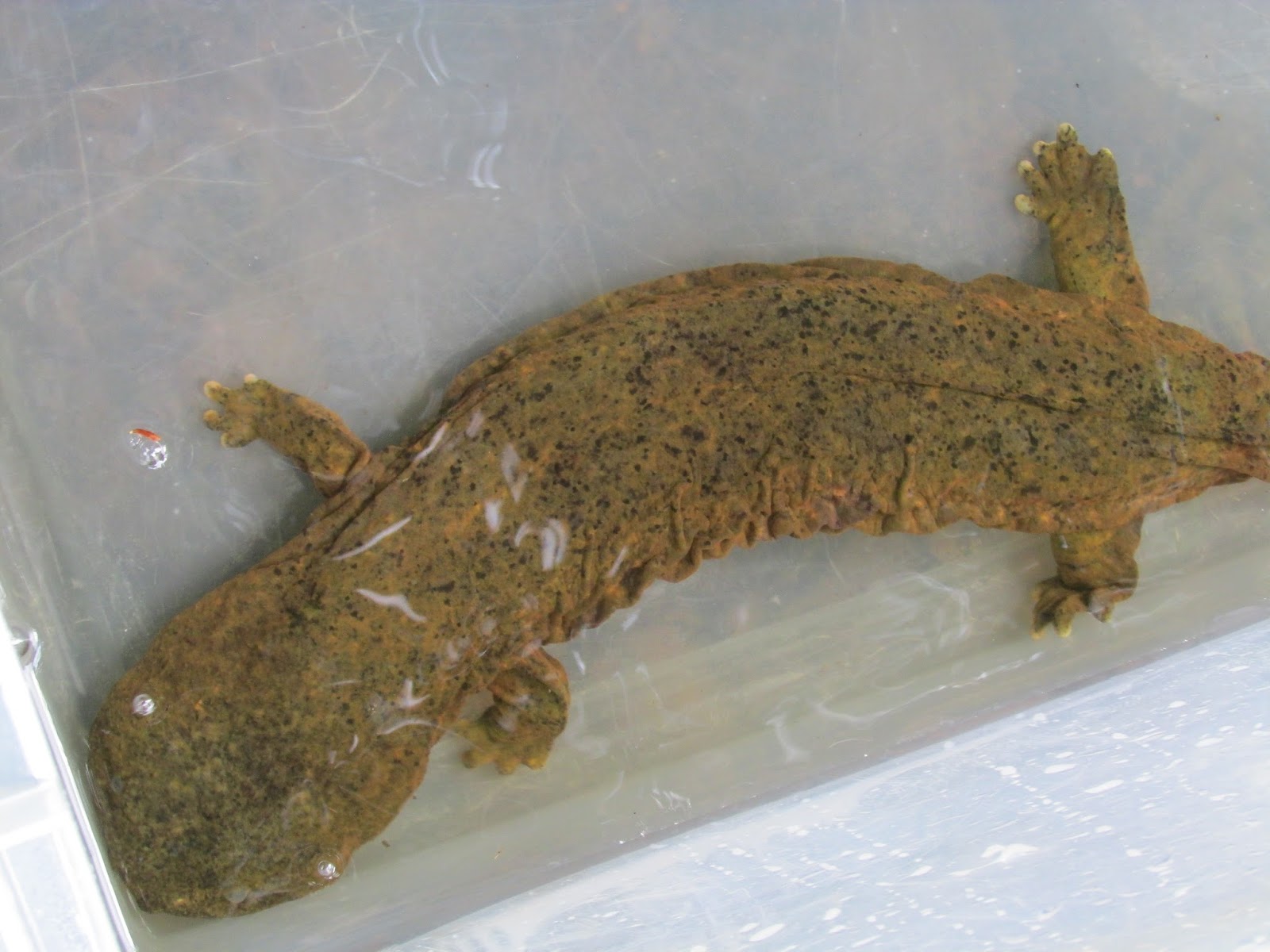


Taking measurements for the newly found adult male. We helped to gather data which included length (snout-vent length and tail length), weight, GPS location, depth of its den, and size of the den. After which, a transmitter was placed in it so that the animal could be readily identified in the future.


Their skin has a wrinkly edge, the animals themselves are coated so well in a slime that they feel very smooth to the touch.


A look at the underside of their feet.

An adult with a wound on its leg, which is a regular occurrence. As was mentioned earlier, they will defend their dens ferociously, to death even.


Another adult being measured. We ensured that the animals remained moist, to prevent desiccation, and to reduce their stress.


At times, they would allow you to pose them, however, when they struggled it was highly difficult to maintain a hold on them (imagine gripping a wet, wriggling bar of soap).


We also saw some other cool animals:
A mountain dusky salamander (Desmognathus ochrophaeus)


Slimy salamander (Plethodon glutinosis)


Bullfrog (Rana catesbeiana)


A little American toad (Anaxyrus americanus)


A lovely lamprey, being its parasitic self.
Photo Courtesy of Jonathan Gorman
For more information on the work that Mr. Roblee and the Buffalo Zoo have been doing, see: http://www.dec.ny.gov/public/73572.html


 Post and Undesignated Photos by:
Joey Chase

Monday, August 29, 2011

Hellbender Trip 2011

The Cornell Herpetological Society annual hellbender trip took place this past Saturday, August 27.  We saw four hellbenders and had lots of fun! The herp club owes a big thanks to Ken Roblee, who generously spent his day guiding us and teaching us about these amazing creatures. The trip is something the club has been doing nearly every year for about two decades, and we are really lucky to have the opportunity to see these little-known animals in the wild. To check out a past trip, take a peek at this blog.

For those of you who have never heard of hellbenders before, they are giant (up to 2 feet or more) aquatic salamanders that live in the eastern United States. Other names for them include snot otter and grampus. Their scientific name, Cryptobranchus alleganiensis, comes from the ancient Greek words "kryptos" (hidden) and "branchos" (gill).

Adults are found under large, flat rocks in streams. Males battle each other for access to the best rocks, where females will later come to lay their eggs. The male will then fertilize the eggs externally (unlike most salamanders, which fertilize internally) and guard the eggs until they hatch.

We spent the day flipping these large, flat rocks in hopes  of finding hellbenders. We generally had two people lift the rock up, two hold large nets downstream from the rock to catch runaway hellbenders, and one or two feel around for the salamanders and guide them into the nets.

Searching:


Hellbenders!


We even found a mudpuppy, Necturus maculosus
(notice the external gills):


Whenever we caught a hellbender, we took data such as weight, total length, snout to vent length, sex, and gps coordinates. Ken PIT-tagged any hellbender that was deemed large enough. PIT stands for Passive Integrated Transponder, and is a tiny electronic tag that can transmit a unique code composed of a series of numbers and letters. The tag is implanted using a hypodermic needle.

Weighing:

Measuring:


Inserting a PIT tag:

We eventually moved to another stream where juveniles from a head-starting program at the Buffalo Zoo have been released. Although hellbenders can live up to 40 years, they are being wiped out in a lot of the streams where they once lived, and the situation is looking grim. Even in streams where they are still present, there are not as many juveniles as there should be, indicating that they aren't breeding as successfully as they once were. The program at the Buffalo Zoo is meant to raise young hellbenders until they are big enough to have a better chance at surviving, and then release them back into the wild. Before they are released, zoo staff implant PIT tags so that they can be monitored with a device that looks like a metal detector. It can detect the tags even through several inches of rock, making it easier to monitor the population without disturbing too many individuals.

Looking for PIT-tagged juveniles:

It started to get late and we finally had to pack up and come back to Ithaca tired but excited about the incredible experience. Now we are looking forward to seeing young hellbenders in the head-start program at the Buffalo Zoo on our October field trip. Hopefully hellbender conservation efforts like theirs will be successful, and we will continue to see them in the wild for years to come.


Photos: Brian Sherman

Post by Jessica Tingle