Wednesday, May 16, 2012

Spring Herp Survey in Roy Park Preserve

On Sunday, April 29, the Cornell Herpetological Society held its 17th spring herp survey. We went to Roy Park Preserve, one of the many preserves owned by the Finger Lakes Land Trust. Tom Reimers and Betsy Darlington from the FLLT generously spent their morning leading the herp club through the preserve as they have for many of our previous herp surveys. This particular preserve was one that the club had visited before in 2008. Roy Park Preserve has a wide array of different habitats, ranging from creek, to forest, to vernal pools, to a beaver pond. Although the day was cold compared to our sweltering hot (for Ithaca) month of March, we found a pretty good variety of species, including one very special species that we rarely see during our surveys.

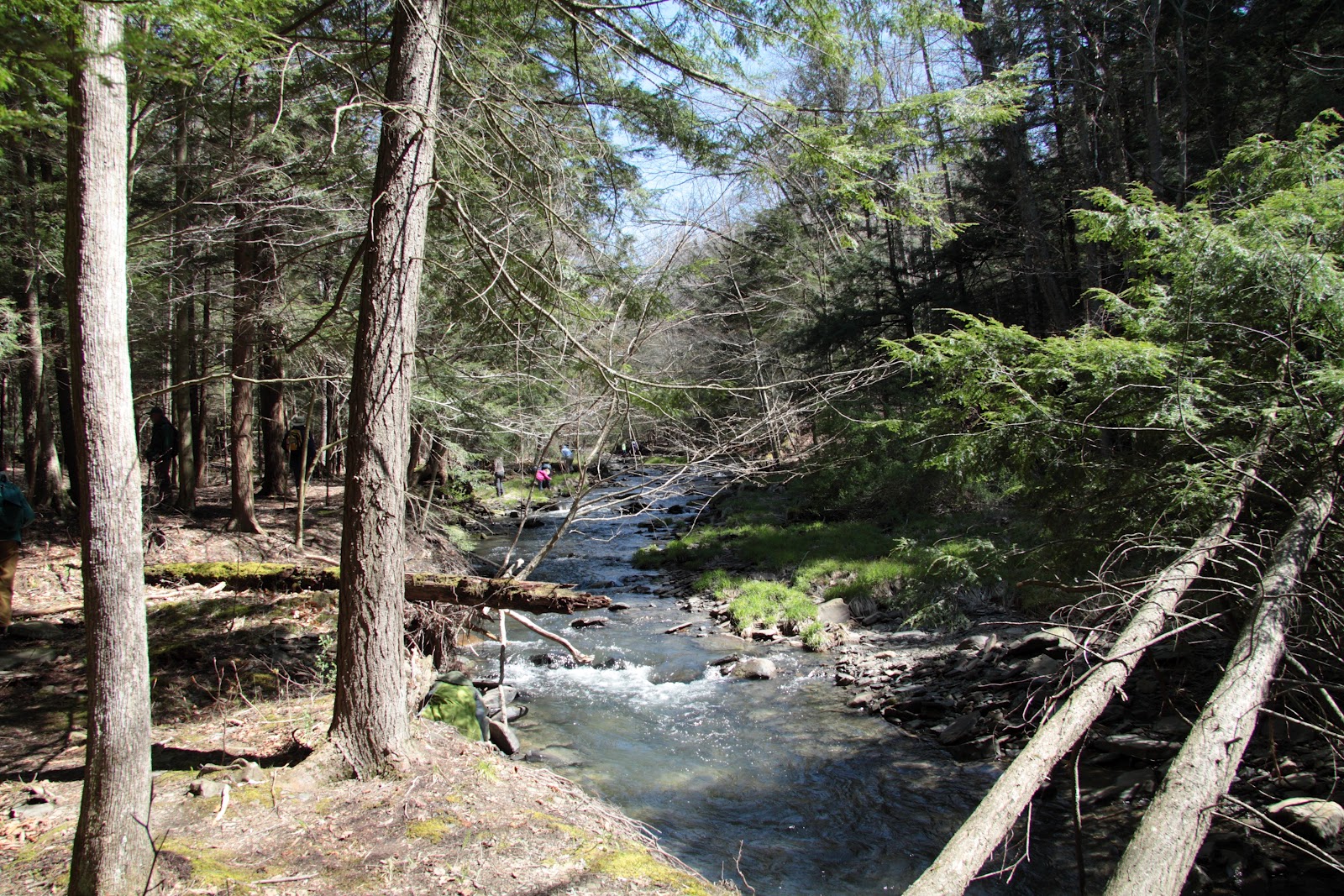
We began our day along Six Mile Creek, a body of water near and dear to the City of Ithaca since it provides our drinking water.


We broke the record for number of spring salamanders found in a trip. Spring salamanders are in the same family as redback salamanders: Plethodontidae, or lungless salamanders. They are nowhere near as common as the redbacks and they are more likely to be in creeks rather than under logs, making them harder to find.

Adult spring salamander, Gyrinophilus porphyriticus

Young spring salamander- notice the gills


While searching the creek, we also found several aquatic adult red spotted newts, Notopthalmus viridescens. You may be familiar with their juvenile form, the brightly colored terrestrial red efts.

Adult red spotted newt

We also flipped rocks and logs near the creek and found plenty of other critters. We saw lots of redback salamanders and also several dusky salamanders. Two species of dusky salamanders (also in the family Plethodontidae) inhabit this part of the country. Ironically, the common dusky salamander, Desmognathus fuscus, is highly uncommon here. The mountain dusky salamander, Desmognathus ochrophaeus, is much more common. It is nearly impossible to tell the two species apart.

Dusky salamander


Our first reptile of the day showed up next to Six Mile Creek.

Garter snake, Thamnophis sirtalis


The site included several vernal ponds. You may remember from our salamander migration post that spotted salamanders (Ambystoma maculatum) and Jefferson's salamanders (A. jeffersonianum) breed in vernal ponds during the early spring. We saw several egg masses in these ponds, and Anna valiantly fished one out for a closer look.


Eventually we climbed up the hill to new habitat and found a beaver pond that held several more red spotted newts.


On a nearby ridge several snakes were busy sunning themselves, including a garter snake with an especially pretty pattern...


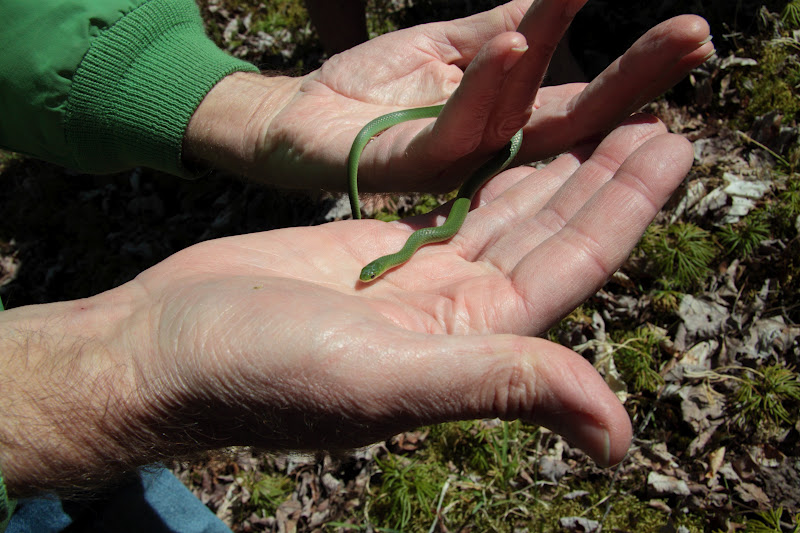
... and the find of the day! A smooth green snake, Opheodrys vernalis!


This little guy or girl completely made the day. Smooth green snakes are a species that we rarely see during our herp surveys, so finding this one was a fantastic way to end the trip!


Final species count (this is only a partial count since it was hard to keep track of so many herpers' finds)
Redback salamander, Plethodon cinereus: 23 (2 leadback phase)
Dusky salamander, Desmognathus sp: 14
Two-lined salamander, Eurycea bislineata: 10
Spring salamander, Gyrinophilus porphyriticus: 4
Green frog, Rana clamitans: 3
Wood frog, Rana sylvatica: many tadpoles
Spring peeper, Pseudacris crucifer: heard many
Spotted salamander, Ambystoma maculatum: egg mass
Garter snake, Thamnophis sirtalis: 4
Smooth green snake, Opheodrys vernalis: 1
Unidentified turtle: 1


Photos: Jessica Tingle

Post by Jessica Tingle

Friday, March 16, 2012

Herp Club Alumni Describe Smallest Known Vertebrate

Early this year, several online journals including National Geographic and the BBC reported on the latest vertebrate described as the world's smallest at an average body size of only 7.7 mm, a tiny frog species from Papua New Guinea (Paedophryne amauensis).  The news especially excited us in the Cornell Herpetological Society because three out of five authors of the paper that described it are among our recent club alumni and former presidents: Eric Rittmeyer (class of ’08), Derrick Thompson (class of ’09) and Mike Gründler (class of ’10). You can find their article on PLoS One.

Paedophryne amauensis on a dime
 
Eric, Derrick, and Mike started the journey that would ultimately lead to New Guinea while they were still undergrads at Cornell. The idea came from a vertebrates class guest lecture by Ed Scholes, who studies birds of Paradise in New Guinea. In the fall of 2007, they went to Dr. Kraig Adler (the herp club’s advisor) and presented their idea. Dr. Howie Evans of the vet school also helped them out, giving them valuable information drawn from his own experience in New Guinea. They decided to do a transect starting on the coast of New Guinea and heading up a mountain into the interior of the country in an attempt to examine the turnover in herp species composition across an elevation gradient.
 
Once their plan began to form, they needed to raise money for the venture, which they estimated would require roughly $25,000. Dr. Adler had friends affiliated with the Bishop Museum who were starting a field station in New Guinea, and Allen Allison of the museum agreed to help the three undergrads after Dr. Adler sent Mike’s proposal.  More help came in the form of $2,000 from a herp club grant provided by an anonymous donor. By the time Eric, Derrick, and Mike went to New Guinea, they had managed to raise $13,000. The Bishop Museum covered their other expenditures in the the country.

The trio worked hard to prepare for the trip. For the fall field trip, the herp club visited Harvard’s Museumof Comparative Zoology, which has a very large collection of New Guinea herps. Dr. Adler tipped off the museum’s director Jim Hanken, who made a point to show the club many of the New Guinea specimens. He also allowed the future explorers to come back to Harvard during spring break to familiarize themselves with the animals and take photos in preparation for their project. Their preparation also included a trip to get a feel for working outside of the temperate zone: in January 2008 they went to Costa Rica with several other herp club members to practice working in a tropical environment.

Finally the summer arrived and our heroes made the long trip to New Guinea. When they got there, it turned out that the coastal village where they were staying had been in recent conflicts with a neighboring village farther inland, and carrying out their original transect up the mountain would put them in danger from the conflict. They could not safely go more than 1000 meters above sea level, so they ultimately did general surveys and collected specimens at several low elevation sites.

Mike and Derrick

Eric


The transects provided baseline data for long-term frog population monitoring and also produced species unreported from the area, including several previously undescribed species: Paedophryne amauensis, now the world’s tiniest known vertebrate, Paedophryne swiftorum, a close relative, and a species of Choerophryne, another microhylid frog with a distinct elongate snout. The latter species was known from a single specimen, and during one night they managed to collect a female and five male specimens as well as record the calls of three different males.

Paedophryne swiftorum

Paedophryne amauensis


Eric Rittmeyer graduated from Cornell in 2008 and went to Louisiana State University to pursue his PhD in the lab of Dr. Christopher Austin. He returned to New Guinea in 2009 and collected specimens and tissues of Carlia eothen, a species in a group of skinks that he is focusing on for his dissertation. Eric will be giving a talk about his research to the herp club on April 23.

Derrick Thompson graduated in 2009. He moved to Thailand, where he now teaches.

Mike Gründler  graduated in 2010 and spent time in Trinidad studying guppies, then at Archbold Field Station in Florida studying sand skinks and beetles. Now he is a Luce Foundation fellow in Mongolia translating Futuyma’s evolution textbook from English into Mongolian.


Photos courtesy of Eric Rittmeyer

Post by Jessica Tingle

Saturday, March 10, 2012

Salamander Migration

The weather is getting warmer and rainy, and that means it's about time for salamanders to start migrating from the woods to breeding ponds.

The salamanders you will see in vernal ponds around Ithaca are in the family Ambystomatidae. The two likeliest species are spotted salamanders (Ambystoma maculatum) and Jefferson's salamanders (Ambystoma jeffersonianum), though just north of Ithaca is a hybrid zone between Jefferson's salamander and it's northerly relative the blue-spotted salamander (Ambystoma laterale). They are relatively large salamanders measuring 5-7 cm and sporting heavier bodies than many of our other local salamanders.


Spotted salamander, Ambystoma maculatum


They spend most of the year under debris or underground, but like most amphibians their life cycle is tied to the water. Unlike reptile eggs, amphibian eggs don't have a shell to protect them from desiccation, so females lay their eggs in small ponds or other moist locations. Spotted and Jefferson's salamander courtship and fertilization also take place in the water. 

In the early spring, warm rain signals to these salamanders that it is time to breed. Males and females migrate to their breeding ponds, where the males court the females using pheromones released from their cloacal glands. They may use their their tails to fan the pheromones towards the females underwater. When a female becomes interested, the male walks and she follows him. He deposits a gelatinous packet of sperm called a spermatophore onto the bottom of the pond, then she walks over it and picks it up with her cloaca. Fertilization is internal, as it is with all other salamanders except for Cryptobranchids such as hellbenders.


Ambystoma maculatum in shallow pond


Jefferson's salamanders generally come out earlier in the spring than spotted salamanders do, and have even been known to crawl over snow on their way to the pond.


Ambystoma jeffersonianum braving the snow to breed


Many years, tens or possibly even hundreds of salamanders will come to a pond during a single night in a phenomenon often called explosive breeding. It is a fantastic thing to see and it attracts many people. While going out to see the salamanders provides an exciting night and a good learning experience, we must take care that we do not negatively impact the salamanders and their habitat.

-If you drive to a pond, make sure to park your car far enough away that you do not run over any salamanders that may be crossing the road.

-Each person in your group should have a bright light to see the ground around them. Keep your eyes on the ground and walk slowly, taking care not to step on any animals.

-Salamanders, like all amphibians, have very delicate skin. They easily absorb anything in environment, so touching one when you have lotion, bug spray, or anything else on your hands can harm them very badly. In addition, their skin must stay moist at all times. It is best not to pick them up, but if you do, first get your hands wet with damp leaves or water from the pond (not tap water from a water bottle-it has chlorine that can hurt them).


Notice how he got his hands damp before holding the salamander.


While you are out at the pond, you may hear or see other breeding amphibians. Some that we have locally are spring peepers, pickerel frogs, and wood frogs.


Happy spring and please enjoy the amphibians responsibly!


Photos: Brian Sherman

 Post by Jessica Tingle

Sunday, November 13, 2011

Rochester/Buffalo Trip

On Saturday, October 22, the Cornell Herpetological Society took an all day field trip to the Glor lab in Rochester and to the Buffalo Zoo. It was really exciting to visit the Glor lab because Rich Glor is an alum who was president of the herp club in 1998 and 1999 and who is now a professor at the University of Rochester. His lab focuses on questions of speciation and diversification, mainly in Caribbean Anolis lizards.


Part of the lab consists of a room filled with anoles. Here, lab members can carry out hybridization, behavior, and other types of experiments that require live lizards. Keeping so many live animals in a lab is a lot of work, but it pays off with the ability to do cool studies, like a current one investigating factors influencing male dewlap displays (if you don't know what a dewlap is, check out this clip from Life In Cold Blood: http://www.youtube.com/watch?v=XoDHaXzmaT4).


After visiting the Glor lab, we headed west to Buffalo to check out the zoo. Remember the hellbender trip? Many of the juvenile hellbenders there had been head-started at the Buffalo Zoo, so we got to see where they started out. At the beginning of the program, the zoo collected egg masses and hatched them in captivity. Some of them were released this past summer, more will be released next summer, and the rest will have more time to grow larger before being released. In all cases, they are PIT (passive integrated transponder) tagged before release so that they can be found and identified later.


Behind the scenes, they have quarantine and a breeding program for endangered Puerto Rican crested toads, Bufo lemur. When the eggs hatch, the tadpoles are shipped to Puerto Rico and released. Introductions are more successful for tadpoles than for older toads. Quarantine for amphibians in the zoo is important to prevent the spread of Bd (Batrachochytrium dendrobatidis), a fungal disease that has been wiping out amphibian populations worldwide.


Venomous snakes are kept in a separate room.

Eastern massasauga (rattlesnake), Sistrurus catenatus

Eastern diamondback rattlesnake, Crotalus adamanteus

Lots of turtles!


Pancake tortoise, Malacochersus tornieri


A big uromastyx, Uromastyx sp.

Gator

What's a visit to the zoo without seeing some of the big cats?


Group shot in the reptile house: Zach Hempstead, Sage Hellerstedt, Jessica Tingle, Anna Kusler, Rachel Ruden, Brian Worthington (photo taken by Dr. Kraig Adler)


Glor Lab Website:

Blog on anoles:

Buffalo Zoo:
http://www.buffalozoo.org/index.html


Photos: Jessica Tingle

Post by Jessica Tingle